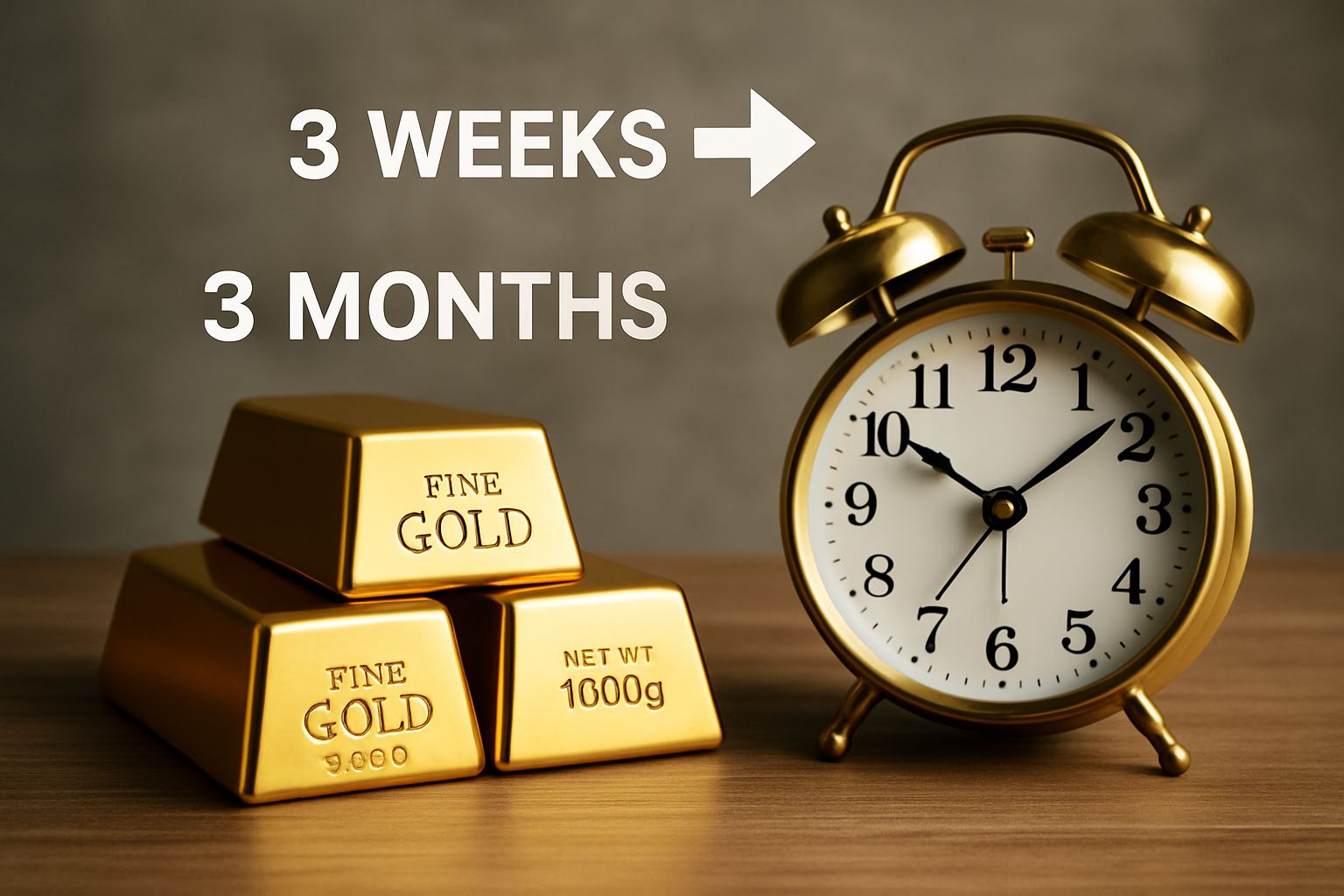
Gold's Dual Role in Your Investment Strategy
Gold isn't just a shiny metal—it's financial insurance with a 5,000-year track record. In today's increasingly uncertain financial landscape, understanding how to properly integrate gold into your investment strategy can mean the difference between merely surviving economic downturns and actually thriving through them. The key is recognizing that gold serves two fundamentally different functions that require distinct approaches: temporary hedging and permanent portfolio anchoring.
Too many investors make the critical mistake of treating these two strategies as interchangeable, often resulting in suboptimal returns and missed opportunities. According to the World Gold Council, investor confusion about gold's proper role leads to inefficient allocation in over 65% of retail portfolios. This misunderstanding often stems from conflating short-term tactical moves with long-term strategic positioning.
Why Gold Matters in Today's Economic Climate
The global financial system faces unprecedented challenges that make gold particularly relevant today. With government debt exceeding $34 trillion in the United States alone and central banks continuing to expand their balance sheets, the risk of currency debasement looms larger than ever. Recent geopolitical tensions, supply chain disruptions, and persistent inflation concerns have only reinforced gold's appeal as both a crisis hedge and wealth preservation tool.
Central banks worldwide have accelerated their gold purchases to record levels, with net acquisitions exceeding 1,136 tonnes in 2022 and continuing this trend through 2023-2024. This institutional vote of confidence signals recognition of gold's enduring value during periods of systemic risk. For individual investors, this central bank behavior provides a valuable clue about prudent portfolio protection strategies in an era of monetary uncertainty.
"In a world of expanding fiat currency supply and increasing sovereign debt, gold remains one of the few financial assets without counterparty risk. Its scarcity and universal recognition make it uniquely positioned as both crisis insurance and a long-term store of value." - Former Federal Reserve Chairman Alan Greenspan
Temporary Hedge vs. Permanent Anchor: The Critical Distinction
Understanding whether you're using gold as a temporary hedge or a permanent anchor fundamentally changes how you should approach your allocation strategy. A temporary hedge is tactical in nature—you're temporarily increasing your gold exposure in anticipation of specific economic conditions like inflation spikes, currency weakness, or market volatility. This approach requires market timing, active management, and typically involves larger but shorter-duration allocations (often 15-25% of your portfolio).
In contrast, a permanent anchor represents a strategic, long-term allocation that remains relatively consistent regardless of market conditions. This approach acknowledges gold's role as insurance against unforeseen events and monetary system failures. Permanent allocations are typically smaller (5-15% of your portfolio) but held consistently through market cycles. The permanent approach requires less active management and timing precision but demands the discipline to maintain your allocation even during periods when gold underperforms other assets.
The decision between these approaches isn't binary—many sophisticated investors maintain a strategic base allocation while tactically adjusting their exposure based on economic conditions. The key is making these adjustments deliberately rather than reactively, with clear criteria for when and how much to adjust your allocation. Your age, risk tolerance, and overall financial situation should heavily influence which approach dominates your gold strategy.
When Gold Shines as a Temporary Hedge
Tactical gold positions work best when you can identify specific economic triggers that historically benefit precious metals. These "gold-friendly" environments typically appear during transitional economic phases rather than during sustained prosperity or deep recessions. Understanding these trigger points allows you to increase your gold allocation precisely when it's most likely to provide portfolio protection.
Economic Crisis Protection
Financial system stress creates ideal conditions for gold's outperformance. During the 2008 Global Financial Crisis, while the S&P 500 dropped 37%, gold gained 5.5%, demonstrating its crisis alpha properties. More impressively, in the 18 months following Lehman Brothers' collapse, gold appreciated 42% while many equities remained underwater. This behavior isn't coincidental—when confidence in financial institutions wavers, gold's physical nature and absence of counterparty risk become particularly valuable.
The effectiveness of gold during crises stems from its negative correlation with systemic risk. Unlike bonds, which depend on the issuer's solvency, gold's value isn't contingent on any entity's promise to pay. This fundamental difference becomes crucial during liquidity crises when even supposedly "safe" assets can experience significant correlation convergence.
Inflation Spikes
Gold has historically served as an effective inflation hedge, though this relationship works better over longer timeframes. During the 1970s inflation crisis, gold delivered a remarkable 1,500% return, substantially outpacing the 170% cumulative inflation rate over that decade. More recently, gold advanced over 15% during the 2021-2022 inflation surge, though with less dramatic outperformance than in previous inflationary episodes.
The key insight for inflation hedgers is that gold anticipates rather than mirrors inflation. Its strongest performance typically comes during the transition from low to high inflation expectations, often moving 12-18 months before official inflation statistics peak. This anticipatory behavior requires investors to position before inflation becomes widely acknowledged—a timing challenge that explains why many investors miss gold's best inflation-hedging moves.
Dollar Weakness Periods
Since gold is priced globally in U.S. dollars, periods of dollar weakness often coincide with gold strength. The inverse relationship is particularly strong during periods of excessive deficit spending and deteriorating government balance sheets. Between 2002 and 2011, a period of significant dollar depreciation, gold appreciated over 600%, demonstrating the powerful effect currency dynamics can have on precious metals.
For tactical hedgers, monitoring the U.S. Dollar Index (DXY) provides valuable signals for potential gold entry points. Sustained breaks below key technical support levels in the dollar often presage significant gold rallies. This relationship makes gold particularly valuable for investors with predominantly dollar-denominated portfolios seeking diversification against currency risk.
Market Volatility Events
Market turbulence frequently drives gold appreciation through the "flight to quality" effect. During the COVID-19 market panic in early 2020, gold initially sold off alongside other assets as investors raised cash, but quickly rebounded to new highs as investors sought safe havens. This pattern of initial correlation followed by divergence appears consistently across volatility spikes, making gold an effective second-phase hedge during market dislocations.
The VIX index, which measures market volatility expectations, often provides useful signals for tactical gold positioning. When the VIX sustains readings above 30, gold typically outperforms in subsequent weeks as investor anxiety translates to safe-haven demand. This relationship makes gold particularly valuable during periods of geopolitical uncertainty or unexpected economic shocks, as highlighted in gold and portfolio risk hedges.
How Much to Allocate for Temporary Protection
Tactical hedging requires more substantial allocations to meaningfully impact overall portfolio performance. For temporary hedges against specific risks, allocations between 15-25% of your portfolio may be appropriate, depending on your conviction level and risk tolerance. These larger allocations are designed to provide meaningful protection during shorter timeframes when you anticipate conditions particularly favorable to gold.
"The mistake most investors make with gold isn't owning too much, but rather owning too little at exactly the wrong time. Effective hedging requires conviction and meaningful position sizing." - Rick Rule, Renowned Resource Investor
Gold as a Permanent Portfolio Anchor
Beyond tactical positioning, gold serves a crucial strategic role as a permanent portfolio component. This approach views gold not as a speculative position to time in and out of, but as essential financial infrastructure that remains in place regardless of current market conditions. The permanent approach acknowledges that gold's primary value comes from insurance against unpredictable systemic risks rather than from optimized returns.
Gold as a Permanent Portfolio Anchor
Beyond tactical positioning, gold serves a crucial strategic role as a permanent portfolio component. This approach views gold not as a speculative position to time in and out of, but as essential financial infrastructure that remains in place regardless of current market conditions. The permanent approach acknowledges that gold's primary value comes from insurance against unpredictable systemic risks rather than from optimized returns.
The Case for 5-15% Permanent Allocation
Research from portfolio theorists suggests that a permanent gold allocation between 5-15% provides optimal diversification benefits without significantly sacrificing long-term returns. This "sweet spot" allocation offers meaningful protection during financial stress while allowing the majority of your portfolio to capture growth from productive assets. A landmark study by Oxford Economics found that a 10% gold allocation improved portfolio risk-adjusted returns across most major investment periods, with particularly strong benefits during periods of market stress.
Unlike tactical allocations that might reach 20-25% temporarily, permanent allocations must be sustainable through gold's inevitable flat or negative performance periods. This sustainability requirement generally caps strategic allocations at around 15% for most investors. Higher permanent allocations may be appropriate for investors with particularly strong concerns about monetary stability or those in countries with historically unstable currencies.
DiscoveryAlert's wealth preservation specialists recommend calibrating your permanent allocation based on your investment timeline and risk tolerance rather than attempting to time the market. For most investors pursuing financial freedom, maintaining a consistent 7-12% allocation through regular rebalancing strikes an appropriate balance between protection and growth potential.
Long-Term Wealth Preservation Benefits
Gold's most compelling case as a permanent holding comes from its remarkable record of wealth preservation across centuries. While currencies have consistently lost purchasing power over extended periods, gold has maintained its ability to command similar quantities of goods and services. The oft-cited example of the Roman toga, purchasable with one ounce of gold in ancient Rome and still approximately equivalent to a fine men's suit with one ounce today, illustrates this preservation power across millennia.
For intergenerational wealth planning, this preservation characteristic becomes particularly valuable. Assets intended to last beyond your lifetime benefit from gold's proven ability to withstand monetary debasement, political transitions, and economic paradigm shifts. Unlike many financial assets that can be rendered worthless through default or hyperinflation, physical gold maintains intrinsic recognition and value across virtually all societies and economic systems.
Protection Against Currency Debasement
The most compelling reason for a permanent gold allocation is protection against ongoing currency debasement. Since the abandonment of the gold standard in 1971, all major currencies have lost over 97% of their value relative to gold. This isn't a temporary phenomenon but represents the structural reality of fiat monetary systems that consistently expand the money supply faster than economic growth.
Central banks worldwide have dramatically expanded their balance sheets since the 2008 financial crisis, with the Federal Reserve alone increasing its assets from $800 billion to nearly $9 trillion at its peak. This unprecedented monetary expansion, combined with fiscal deficits projected to exceed $1 trillion annually for the foreseeable future, creates conditions historically favorable for precious metals over multi-decade timeframes. For investors planning financial independence decades into the future, this monetary reality makes a permanent gold allocation particularly prudent.
Real Performance Data That Should Guide Your Decision
Making informed decisions about gold allocation requires understanding its actual historical performance rather than relying on anecdotal evidence or conventional wisdom. While gold advocates and critics both selectively cite data to support their positions, the complete performance record offers more nuanced guidance for sophisticated investors.
Gold vs. Stocks: 50-Year Return Comparison
Since 1971 when gold began freely trading, stocks have substantially outperformed gold over the full period. The S&P 500 has delivered an annualized return of approximately 10.5% compared to gold's 7.8%. However, this full-period comparison obscures crucial nuances in how these returns were distributed over time. Gold dramatically outperformed during the 1970s and 2000-2011 periods, while stocks dominated the 1980s, 1990s, and 2012-2020 periods.
This alternating leadership demonstrates that neither asset consistently dominates across all economic environments. Instead, they complement each other, with each providing superior returns during different economic regimes. This complementary relationship supports the case for maintaining both assets in a balanced portfolio rather than attempting to time switches between them.
Gold's Performance During the 5 Major Market Crashes
Gold's behavior during market crises provides compelling evidence for its diversification benefits. During the five worst stock market drawdowns since 1971, gold has averaged a positive return of 12.2% while stocks lost an average of 39.4%. This "crisis alpha" demonstrates gold's effectiveness as portfolio insurance precisely when that protection is most valuable.
- 1973-1974 Oil Crisis: S&P 500 -48%, Gold +73%
- 1987 Black Monday: S&P 500 -33%, Gold +6%
- 2000-2002 Dot-com Bubble: S&P 500 -49%, Gold +12%
- 2008 Financial Crisis: S&P 500 -57%, Gold +25%
- 2020 COVID Crash: S&P 500 -34%, Gold -3% (initially fell, then quickly recovered)
This data reveals that gold's protective qualities aren't merely theoretical but have delivered tangible portfolio benefits during actual market crises. While past performance doesn't guarantee future results, gold's consistent behavior across diverse crisis scenarios suggests its protective characteristics stem from structural rather than coincidental factors.
Opportunity Cost Analysis
The primary objection to permanent gold allocation centers on opportunity cost—capital allocated to gold isn't invested in potentially higher-returning assets like equities. This opportunity cost is real and should be factored into allocation decisions. However, focusing solely on return maximization overlooks the volatility reduction and drawdown protection gold provides, which can significantly improve risk-adjusted returns and withdrawal sustainability.
For investors approaching or in retirement, reducing sequence-of-returns risk through gold allocation may actually enhance long-term returns by allowing larger allocations to equities elsewhere in the portfolio. Monte Carlo simulations demonstrate that portfolios with 10-15% gold allocations support higher sustainable withdrawal rates despite slightly lower average returns, primarily by reducing the severity of worst-case scenarios. This protection against catastrophic outcomes represents value beyond what simple return comparisons capture.
Implementation Strategies Based on Your Goals
The practical mechanics of implementing your gold strategy significantly impact its effectiveness. Different vehicles for gold ownership serve different objectives, with important tradeoffs between liquidity, security, taxation, and cost structure.
Physical Gold vs. ETFs vs. Mining Stocks
Physical gold ownership provides maximum security against financial system risks but introduces storage, insurance, and liquidity challenges. For true crisis protection, physical gold held outside the banking system offers unparalleled security but typically incurs annual storage costs of 0.5-1.5%. Gold ETFs like GLD and IAU offer superior convenience and liquidity with minimal tracking error, making them ideal for tactical positions or smaller permanent allocations where immediate accessibility matters more than systemic risk protection.
Mining stocks represent a leveraged bet on gold prices rather than direct exposure to the metal itself. Companies like Newmont, Barrick, and Franco-Nevada offer operational leverage to gold prices, potentially delivering amplified returns during bull markets but also underperforming gold during price declines or when facing operational challenges. For investors comfortable with equity risk, allocating a portion of your gold exposure to high-quality miners with strong balance sheets can enhance returns while maintaining some correlation to gold prices.
Tactical Entry and Exit Points for Hedgers
Successful tactical hedging requires disciplined entry and exit criteria rather than emotional reactions to headlines. Technical indicators like the 50/200-day moving average crossover have historically provided useful signals for gold entry points, with positive forward returns following golden cross events in over 70% of instances since 1975. Fundamental indicators like real interest rates (measured by 10-year Treasury yields minus inflation) demonstrate strong inverse correlation with gold prices, with negative real rates consistently supporting higher gold valuations.
For tactical hedgers, predefined exit criteria are even more important than entry points. One effective approach establishes profit targets and stop-loss levels before initiating positions, removing emotional decision-making during volatile periods. Alternatively, fundamental exit triggers like a sustained rise in real interest rates or resolution of the specific risk you were hedging against provide objective criteria for reducing tactical allocations.
Dollar-Cost Averaging for Permanent Holders
For permanent gold allocations, systematic dollar-cost averaging removes timing pressure and reduces purchase price volatility. Establishing a regular purchasing schedule—whether monthly, quarterly, or annually—allows you to build your permanent allocation gradually while reducing the risk of committing capital at cyclical price peaks. This approach acknowledges the impossibility of consistently identifying optimal entry points while ensuring disciplined implementation of your strategic allocation.
Systematic rebalancing represents an enhanced form of dollar-cost averaging that naturally increases your buying when prices decline and reduces purchases when prices rise. Establishing a target allocation percentage and rebalancing when actual allocation deviates by more than 2-3% creates a mechanical buying low/selling high system that enhances long-term returns while maintaining your strategic allocation. This disciplined approach prevents the common mistake of increasing allocation after prices have already risen substantially.
Tax Considerations for Both Approaches
Gold's tax treatment varies significantly across different ownership vehicles, creating opportunities for tax-efficient implementation. Physical gold is taxed as a collectible at a maximum federal rate of 28% for long-term holdings, significantly higher than the 20% maximum rate for stocks. This tax disadvantage makes physical gold particularly suitable for tax-advantaged accounts when crisis protection isn't the primary objective.
ETFs backed by physical gold like IAU and GLD receive the same collectible tax treatment, while mining stocks receive standard capital gains treatment (maximum 20% long-term rate). For taxable accounts where both protection and tax efficiency matter, a combination of mining stocks for long-term holdings and ETFs for tactical positions often provides an optimal balance. Consult with a tax professional about jurisdiction-specific considerations that may affect your optimal implementation strategy.
Common Mistakes That Cost Gold Investors Money
Despite gold's straightforward nature, behavioral and implementation errors frequently undermine its effectiveness in actual portfolios. Understanding these common pitfalls can help you avoid costly mistakes that prevent gold from fulfilling its intended role in your investment strategy.
The biggest gold investing errors typically stem from emotional rather than analytical factors. The psychological security gold provides often leads investors to make decisions based on fear rather than objective criteria, resulting in poorly timed transactions and inappropriate allocation sizes.
Timing the Market
The most expensive mistake gold investors make is attempting to time entries and exits based on price momentum or headlines. Studies of investor behavior show that the average gold investor underperforms the metal itself by approximately 2.3% annually due to ill-timed transactions. This timing penalty often results from buying after significant price increases when media coverage peaks and selling during extended flat periods out of impatience. Successful gold ownership requires either strict discipline about timing criteria or, more realistically for most investors, maintaining consistent allocations regardless of short-term price movements.
Overallocation During Fear Cycles
Financial anxiety frequently drives excessive gold allocations that prove unsustainable through full market cycles. During periods of heightened economic uncertainty, some investors allocate 30-50% or more to precious metals, creating significant opportunity cost when markets eventually stabilize. This overallocation pattern becomes particularly destructive when combined with poor timing, resulting in large positions established near cyclical peaks.
The antidote to fear-driven overallocation is establishing your gold strategy during periods of market calm rather than crisis. Determining appropriate allocation percentages before fear becomes the dominant market emotion allows for rational decision-making based on your actual risk tolerance and financial objectives rather than temporary emotional states.
Ignoring Storage and Insurance Costs
Physical gold ownership entails ongoing costs that significantly impact long-term returns but are frequently overlooked in purchase decisions. Secure storage solutions typically cost 0.5-1.5% annually, while insurance adds another 0.3-0.8% depending on coverage levels and location. Over decades, these seemingly modest expenses compound to substantial amounts that must be factored into return expectations. For permanent allocations held for 20+ years, these costs can reduce effective returns by 20-30% compared to the spot price performance.
Creating Your Gold Strategy: Next Steps
Developing an effective gold strategy requires translating general principles into a specific plan aligned with your financial timeline and objectives. Begin by honestly assessing whether you're primarily seeking temporary protection against specific risks or permanent insurance against systemic financial uncertainty. This fundamental determination will shape every subsequent decision about implementation, allocation size, and vehicle selection.
DiscoveryAlert's wealth preservation specialists recommend documenting your gold strategy with specific triggers for adjusting allocations, rebalancing criteria, and implementation vehicles before making initial purchases. This documented approach prevents emotional decision-making during volatile periods and ensures your gold allocation serves its intended purpose rather than becoming a source of anxiety or regret. Whether you choose a tactical approach, a permanent allocation, or a combination of both, clarity about your objectives will significantly improve your results.
Frequently Asked Questions
The following questions represent the most common concerns investors raise when implementing gold strategies. While general guidelines provide useful starting points, your specific financial situation may require customized approaches.
What percentage of my portfolio should I allocate to gold?
The appropriate allocation depends on your investment timeline, risk tolerance, and overall financial situation. For permanent strategic allocations, research suggests 5-15% provides optimal diversification benefits without significantly sacrificing long-term returns. Tactical allocations may temporarily reach 15-25% during specific economic conditions favorable to gold. Your age also matters—investors under 40 typically benefit from lower allocations (5-10%) while those approaching or in retirement may justify higher allocations (10-15%) for sequence-of-returns risk protection. DiscoveryAlert's wealth protection specialists recommend starting with a 10% allocation and adjusting based on your specific risk concerns and comfort level.
Is physical gold better than gold ETFs or mining stocks?
Each vehicle serves different objectives with important tradeoffs. Physical gold provides maximum protection against financial system risks but introduces storage, insurance, and liquidity challenges. Gold ETFs offer superior convenience and liquidity with minimal tracking error, making them ideal for tactical positions. Mining stocks provide operational leverage to gold prices, potentially delivering amplified returns during bull markets but also underperforming during price declines. For comprehensive protection, consider allocating across multiple vehicles—perhaps 50% in physical gold for true crisis protection, 30% in ETFs for liquidity, and 20% in quality miners for growth potential.
How quickly can I liquidate gold in an emergency?
Liquidity varies dramatically across different ownership forms. Gold ETFs like GLD can be sold instantly during market hours with settlement in two business days. Physical gold held at home can be converted to cash within 1-3 days through reputable dealers, though potentially at 2-5% below spot price during normal markets and wider spreads during crises. Allocated gold held in professional vaults typically requires 2-5 business days for liquidation and fund transfer. This liquidity spectrum highlights why comprehensive protection may require maintaining gold in multiple forms—immediate needs covered by ETFs while physical holdings provide longer-term security.
Does gold really protect against inflation in the short term?
Gold's inflation protection works better over medium to long timeframes than during short-term inflation spikes. Research covering the period since 1971 shows gold has delivered positive real returns during high inflation decades but often with significant lags and volatility. During the 2021-2022 inflation surge, gold initially underperformed inflation before delivering stronger returns as the cycle matured. Gold typically anticipates rather than mirrors inflation, often moving 12-18 months before official inflation statistics peak. This anticipatory behavior makes gold more effective as a strategic inflation hedge than as a reactive tactical position after inflation has already appeared in official statistics.
For optimal inflation protection, consider combining gold with other inflation-sensitive assets like TIPS, commodity producer stocks, and certain real estate segments. This diversified approach provides more consistent protection across different inflation scenarios than relying solely on precious metals.
How do central bank gold purchases affect individual investors?
Central bank buying provides significant support for gold prices by removing substantial supply from the market. Since 2010, central banks have transformed from net sellers to aggressive buyers, with purchases exceeding 1,136 tonnes in 2022 alone—representing approximately 25% of annual global production. This structural demand shift has established a "central bank floor" under the gold market that reduces downside risk for individual investors.
Beyond direct price impact, central bank buying signals institutional recognition of gold's monetary relevance in a changing international financial system. The acceleration of purchases by countries seeking to reduce dollar dependence suggests awareness of potential monetary system changes that individual investors should consider in their own financial planning. While central bank activity shouldn't be the primary driver of your gold allocation decisions, their sustained buying provides validation of gold's continued relevance in the modern financial landscape.